
Ask the Experts Mini Series: A Whole-Body Approach to Jaw & Neck Pain
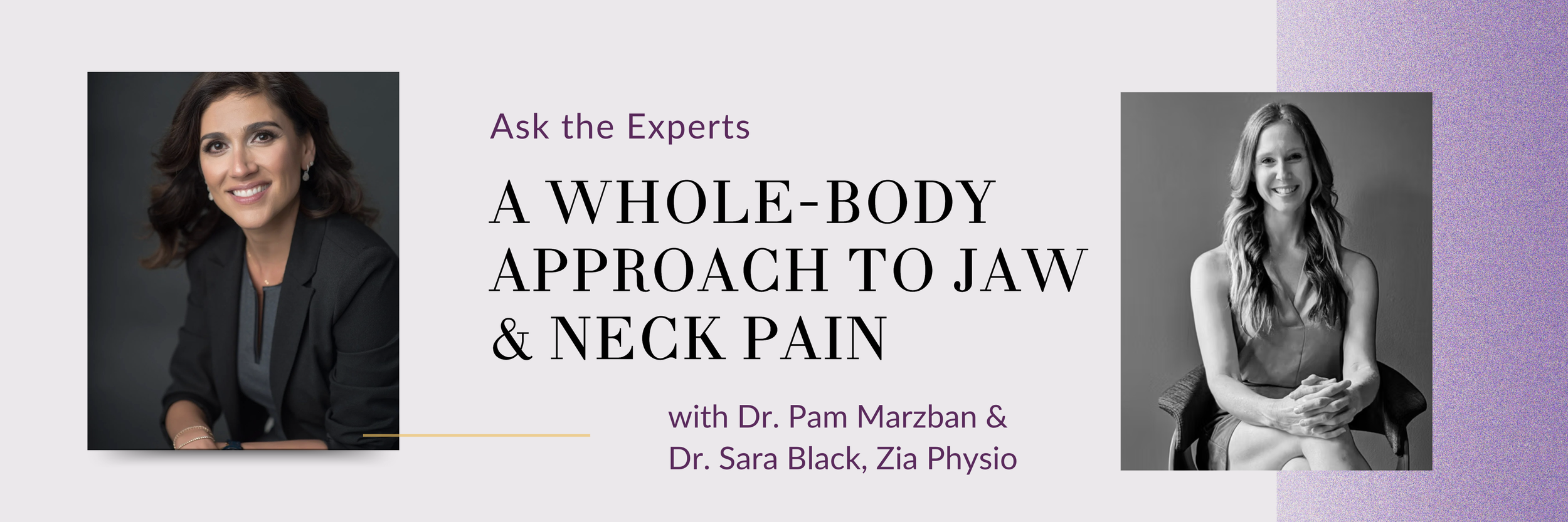
Part 2: How Posture and Breathing Affect Oral Health
Jaw and neck pain rarely exist in isolation. Posture, breathing, muscle patterns, and oral health all interact, and lasting relief often comes from understanding the body as a connected system. In the second part of our Ask the Expert series, Dr. Marzban and Dr. Sara Black of Zia Physio share their perspectives on why jaw pain is often part of something bigger.

Meet Our Guest: Sara Black, PT, DPT, CSCS, CAPP-Pelvic, founder for Zia Physiotherapy
A Richmond native and former Division I swimmer at East Carolina University, Sara Black earned her Doctorate in Physical Therapy from Lynchburg University and brings a strong background in exercise physiology, strength training, and manual therapy. She specializes in pelvic health and complex musculoskeletal dysfunction, with advanced CAPP-Pelvic training, and is passionate about educating patients and empowering them to take an active role in their care.
Let’s dive in: From a Dental Perspective, with Dr. Marzban
How does posture influence jaw position, bite alignment, or wear on the teeth?
Posture directly affects your bite, meaning how your teeth come together.
Try this: tilt your head up slightly and slowly bring your teeth together. You may notice your back teeth touch first. Now bring your head forward into a forward head posture and bite. You’ll often feel the pressure shift toward the front teeth.
Depending on your posture, different teeth get overloaded. Over time, that uneven pressure can lead to cracks, wear, gum recession, and premature breakdown.
Your bite is not just about teeth…it’s influenced by how you hold your head and body.
What role do breathing patterns play in oral health, clenching, or sleep-related issues?
Breathing patterns drive oral health more than most people realize.
When nasal breathing is compromised and someone becomes a mouth breather, the tongue drops from the palate and the jaws lose proper support. That loss of space crowds the airway and forces the body into compensation.
During sleep, if oxygen levels drop or the airway narrows, the nervous system activates, often triggering clenching or grinding as a survival response to stabilize and reopen the airway.
So grinding isn’t just a “stress habit.” It’s frequently the body’s attempt to breathe.
If we don’t address the breathing pattern, we’re only managing the downstream effects.
Are there common habits you see in patients that impact long-term oral health?
Absolutely. The most common habits I see are prolonged desk posture with forward head position, chronic mouth breathing, and unmanaged stress.
Forward head posture shifts how the teeth meet and increases strain on the jaw muscles. Mouth breathing lowers tongue posture and reduces proper jaw support, affecting growth in kids and stability in adults.
Chronic stress also keeps the nervous system in a heightened state, which often shows up as clenching and grinding.
These habits seem small day to day, but over years they reshape the bite, overload certain teeth, and accelerate wear. The mouth reflects how the body is functioning.
From a Physical Therapy Perspective, with Dr. Black
How does modern posture, especially desk and screen habits, affect the neck, jaw, and upper body?
Modern desk and screen posture, especially prolonged forward head position and rounded shoulders, shifts the head in front of the body, forcing the neck and jaw muscles to work overtime just to hold us upright.
This increases tension in the major stabilizing muscles of the head and neck, often leading to clenching, jaw compression, and headaches due to trigger point pain referral.
Over time, that stacked-forward posture also disrupts rib cage and diaphragm mechanics, reinforcing a stress-based breathing pattern that keeps the jaw and upper body in a constant state of tension.
What is the connection between breathing mechanics and muscle tension in the jaw and face?
Breathing mechanics and jaw tension are deeply connected because the diaphragm, rib cage, and jaw all work as part of the body’s pressure system.
When we breathe shallowly from the chest or mouth, the neck and jaw muscles overwork to help stabilize the head and upper airway. Over time, this constant recruitment can cause tightness in the jaw, face, and suboccipital muscles, contributing to clenching, headaches, and overall facial tension.
How can improving posture or breathing patterns reduce strain on the jaw over time?
Improving posture and breathing patterns reduces jaw strain by shifting the work back to the diaphragm, rib cage, and deep core, so the jaw and neck no longer have to compensate for poor alignment or shallow breathing.
Through exercises, muscle retraining, and manual techniques like trigger point release or dry needling, we can relax overactive jaw and neck muscles, restore proper movement patterns, and give the entire pressure system a chance to function efficiently.
As the system becomes more balanced, jaw discomfort can gradually ease over time.
A Whole-Body Approach
Posture and breathing quietly influence how the jaw functions throughout the day and night.
When these patterns are out of balance, the jaw often becomes one of the first places where strain appears. Addressing those underlying habits can support not only jaw comfort but long-term oral health.
In the next part of our Ask the Experts series, we’ll explore the signs that jaw and neck pain may benefit from a collaborative care approach between dentistry and physical therapy.